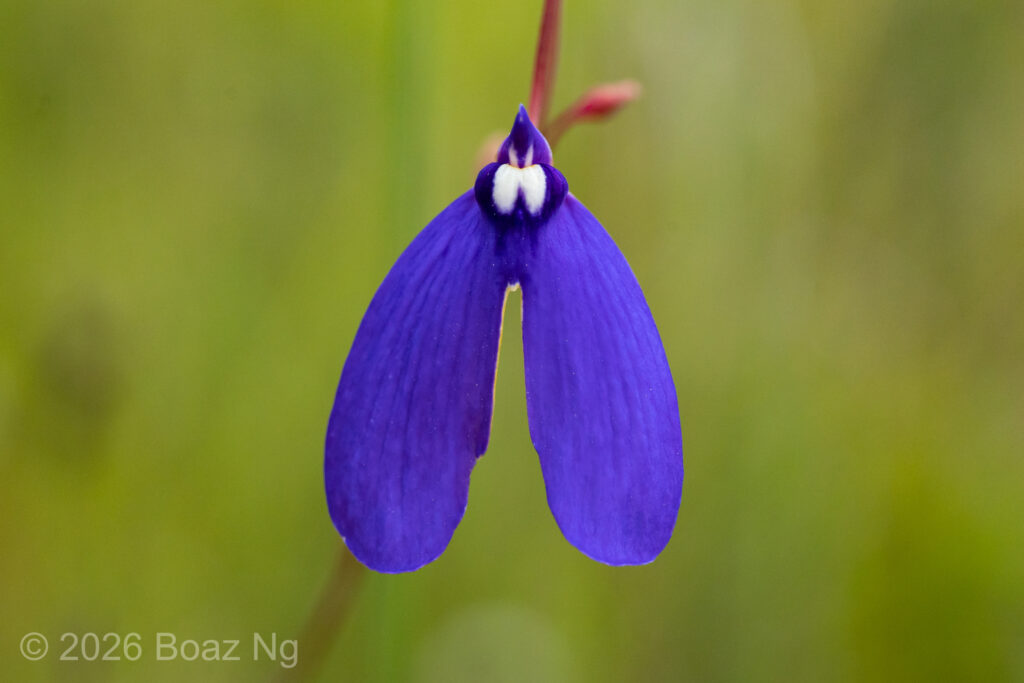

Utricularia leptoplectra is an terrestrial bladderwort endemic to monsoonal regions of the Northern Territory and Western Australia. The species is named for its thin (leptos) nectary spur (plektron).
U. leptoplectra is a large plant with flower scapes that can exceed 50 cm in height, especially when growing under water. The flowers are easily recognised by their distinctively shaped blooms. The lower corolla lip (see: notes on morphology) is deeply divided into two lobes in the shape of a boomerang. A bulbous protruberance is present at the centre of the flower. The upper corolla lip is small. The nectary spur is very long and thin. The blooms are coloured deep purple at the front, with backs ranging from ivory white to yellow or orange. The leaves are deeply divided with divisions that emerge along a central vein.
The species grows in shallow water at the edges of seasonal billabongs and melaleuca swamps, as well as in seasonally inundated grassy soaks. It is typically associated with wetter niches that are inundated to some degree. When the dry season arrives, the plants are known to put on impressive en mass flowering displays as the waters recede. It has a disjunct distribution across the Top End in the Northern Territory and in the Kimberley region of Western Australia.
The blooms of U. leptoplectra are unlike any other species of bladderwort and are easily distinguished by their deeply divided boomerang shape. It is closely related to U. biloba and U. limosa, with these species forming the Utricularia section Nelipus. This section is united by its bulbous palate and two-lobed lower corolla lip.